
How Grocery Retailers Build Real Time Inventory Systems
Senior engineers building AI-native software for clients worldwide
A practical guide to how grocery retailers build real time inventory and omnichannel fulfillment systems that improve accuracy, substitutions, and delivery.
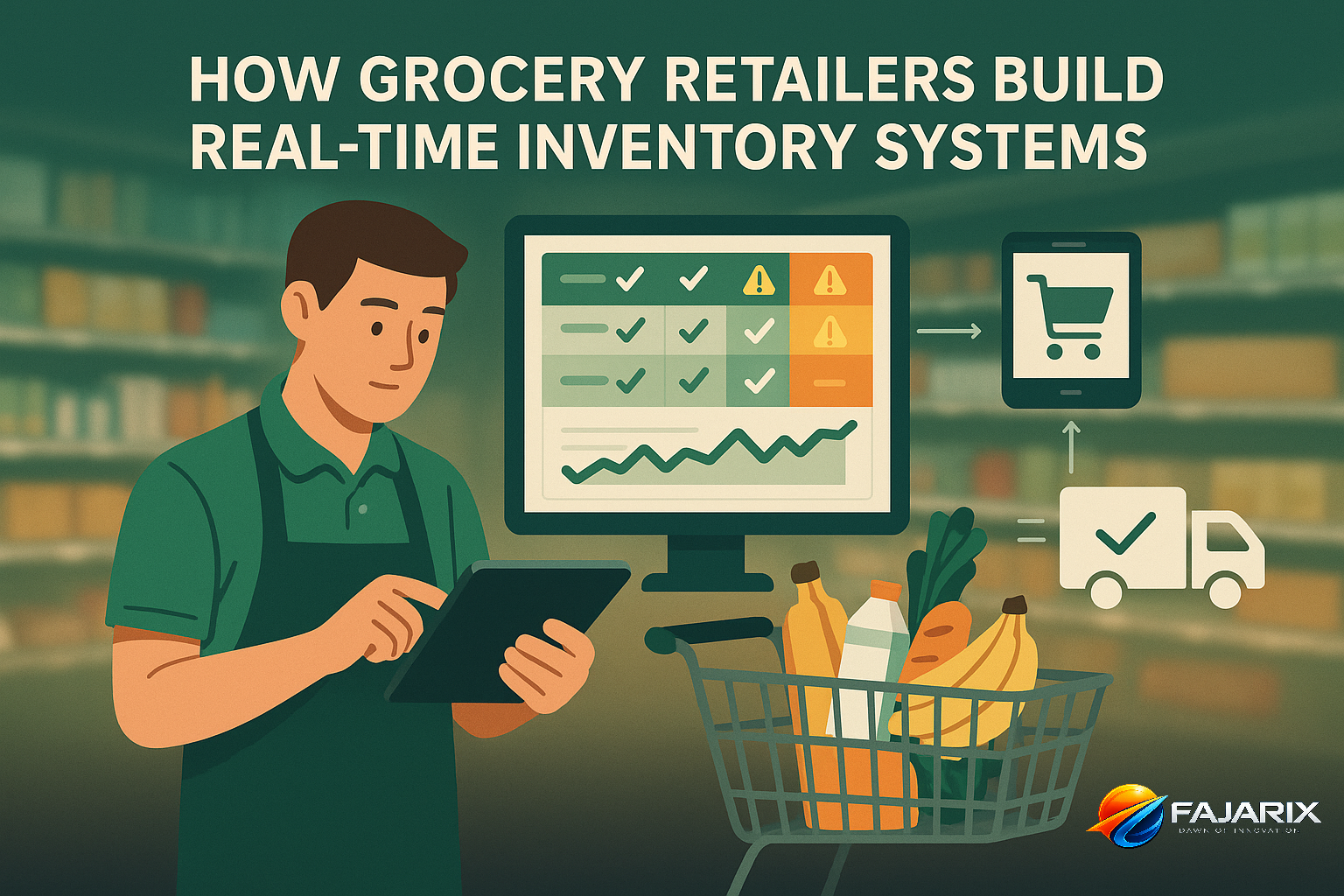
How grocery retailers build real time inventory and omnichannel fulfillment systems is the practice of turning store, warehouse, and digital demand signals into one accurate operational view. In grocery, that means knowing what is sellable now, promising it correctly across channels, handling substitutions intelligently, and routing each order to the best fulfillment path without breaking margin or customer trust.
Search spikes around brands like ShopRite usually reflect a customer event: promotions, delivery demand, outages, weather, or holiday shopping. For a CTO or founder, the interesting question is not why search volume moved. It is what kind of technical stack lets a grocery retailer absorb that demand without showing phantom inventory, creating picker chaos, or disappointing customers at checkout.
The hard part is not building a storefront. It is building the operational truth behind the storefront. Grocery has short shelf life, variable weights, store-level assortment, local substitutions, and labor-constrained fulfillment. That is why how grocery retailers build real time inventory and omnichannel fulfillment systems is fundamentally an architecture problem, not just an app problem.
Why ShopRite-Like Demand Spikes Expose Weak Inventory Architecture
When traffic surges, weak systems fail in predictable ways: cached inventory drifts from reality, substitutions are chosen too late, orders are assigned to the wrong store, and the customer learns the truth only after payment. In grocery, that sequence destroys trust faster than in most retail categories because baskets are need-based, not discretionary.
A modern grocery stack must handle four competing truths at once: on-hand inventory, available-to-promise, pickable inventory, and substitutable inventory. Most failed implementations collapse these into one number. That is the original sin.
If your PDP says “12 available,” but the picker can only find 6 sellable units and 3 are already reserved for curbside, you do not have inventory visibility. You have a misleading integer.
This is where how grocery retailers build real time inventory and omnichannel fulfillment systems becomes operationally specific. The architecture has to support reservation windows, freshness rules, weighted items, and local store constraints in near real time, not in overnight sync jobs.
How Grocery Retailers Build Real Time Inventory and Omnichannel Fulfillment Systems
The winning pattern is not one giant platform. It is a set of bounded services around a shared inventory event model. Retailers that scale well usually separate catalog, inventory ledger, order management, substitution engine, fulfillment orchestration, and customer communication.
The Core Data Model
At minimum, each SKU-location pair needs more than quantity. You need status dimensions such as sellable, reserved, damaged, in-transit, staged, and expired-risk. For fresh items, weight variance and shelf-life windows matter as much as count.
A practical model often includes:
- On-hand: physical count in location
- Reserved: committed to open orders
- Available-to-promise: what digital channels may sell now
- Pick confidence: probability a picker will actually find it
- Substitution group: approved alternatives by store and customer preference
- Freshness attributes: pack date, expiry threshold, temperature zone
The Event Flow
Most robust implementations are event-driven. POS sales, receiving, cycle counts, picker exceptions, returns, and cancellations emit events into a stream, which updates an inventory ledger and downstream read models. Tools commonly used here include Kafka, AWS Kinesis, RabbitMQ, Debezium, and Redis.
The key design choice is whether inventory is computed from events or overwritten by periodic snapshots. In grocery, the answer is usually both: an event-sourced operational ledger for speed and auditability, plus reconciliation jobs against ERP/WMS sources for safety.
The Channel Promise Layer
Your mobile app, website, call center, and marketplace connectors should not all read raw inventory tables directly. They should read from a channel promise service that applies business rules: safety stock, reservation timeouts, store blackout windows, and fulfillment capacity. This layer is where margin protection happens.
That is the practical heart of how grocery retailers build real time inventory and omnichannel fulfillment systems. The customer does not care whether your ERP is elegant. They care whether the promise made at 6:03 PM is still true at 6:19 PM.
How Does Real-Time Grocery Inventory Actually Work?
Real-time grocery inventory works by combining event streams, reservations, and confidence scoring. The system does not merely count stock. It continuously updates what can be sold, what is already committed, and what is likely to be found by a picker in a specific store.
Here is a practical sequence:
- A POS sale reduces on-hand and emits an inventory event.
- An online basket checkout creates soft reservations for each line item.
- Fulfillment capacity is checked for the requested slot.
- The order management system confirms the order and converts soft holds to timed commitments.
- During picking, exceptions update the ledger in real time.
- If an item is missing, the substitution engine proposes alternatives based on policy and customer preference.
- Final picked quantities update billing, customer notifications, and replenishment signals.
Latency targets matter. In practice, sub-second propagation is ideal for reservations, while 5-30 second consistency may be acceptable for some catalog and merchandising updates. If your inventory updates every 15 minutes, you do not have real-time inventory for grocery. You have delayed synchronization.
What Makes Substitution Logic Good Instead of Annoying?
Good substitution logic optimizes for customer acceptance, basket completion, and margin at the same time. Bad substitution logic treats alternatives as a simple category match, which leads to absurd replacements and refund-heavy orders.
Strong substitution systems use multiple signals:
- Customer preferences: no substitutions, preferred brands, dietary restrictions
- Merchandising rules: approved substitute sets, pack size tolerances, private label strategy
- Operational context: what is physically nearby for the picker, what is in stock now
- Economic logic: margin, refund risk, promo impact, delivery SLA
- Behavioral feedback: acceptance and rejection history by customer and SKU
For mature teams, this starts rule-based and gradually becomes ML-assisted. We generally advise clients not to start with a fully opaque model. A transparent scoring system with a few learned features is easier to debug, easier for store operations to trust, and faster to ship.
Named tools and platforms can help at the edges, but most grocers still need custom logic in their core stack. Teams may use Optimizely for experimentation, Snowflake or BigQuery for analytics, and LaunchDarkly for feature control, while keeping the actual substitution engine inside their product layer or order service.
How Should Fulfillment Orchestration Decide Between Pickup, Delivery, and Ship?
Fulfillment orchestration should choose the option that meets the promise at the lowest operational cost without harming customer trust. That means routing is based on inventory position, slot capacity, labor availability, distance, basket composition, and service-level commitments.
For grocery, the orchestration engine usually evaluates:
- Nearest feasible store or dark store
- In-store picking versus micro-fulfillment center picking
- Pickup versus last-mile delivery
- Single-node versus split-order fulfillment
- Cold-chain handling requirements
- Driver availability and cutoff times
A useful decision table looks like this:
| Decision Area | Best Default | When to Override |
|---|---|---|
| Store vs MFC | Use store for broad local assortment | Use MFC when order density and automation justify it |
| Split Orders | Avoid by default | Allow for high-value baskets or stockout recovery |
| Substitute vs Refund | Substitute for staples | Refund for allergy, brand-sensitive, or premium items |
| Delivery Slot Promise | Conservative capacity buffers | Expand dynamically if picker throughput is ahead of plan |
| Inventory Reservation | Reserve at checkout | Delay hard allocation if inventory confidence is low |
This is where how grocery retailers build real time inventory and omnichannel fulfillment systems intersects with logistics software. The orchestration layer is effectively a retail-specific logistics engine with stronger customer-facing promise requirements.
What Architecture Pattern Works Best for Omnichannel Grocery?
The best pattern is modular, event-driven, and operationally observable. Grocery teams often regret both extremes: monoliths that cannot evolve and over-fragmented microservices that create coordination overhead before the business is ready.
A Practical Reference Stack
- Storefronts: web and mobile apps, often
Next.js,React,iOS,Android - API Layer:
RESTorGraphQLgateway with auth, rate limiting, and caching - Order Management: custom service or commerce OMS
- Inventory Ledger: event-driven service with fast read models
- Search and Catalog:
Elasticsearch/OpenSearchplus merchandising rules - Fulfillment Engine: slotting, routing, labor capacity, exceptions
- Messaging: SMS, email, push for substitutions and ETA changes
- Data Platform: warehouse plus real-time monitoring and BI
Resilience Requirements CTOs Underrate
In our experience at Fajarix, teams often focus on throughput and forget degraded-mode design. Grocery systems need graceful fallback behavior when a store scanner is offline, a marketplace API rate-limits you, or the inventory feed lags. The question is not whether a dependency fails. It is whether checkout still behaves safely when it does.
One Fajarix-specific lesson from production work: do not let the checkout path depend on synchronous calls to every downstream system. We prefer a fast promise service with bounded freshness and explicit confidence levels, backed by asynchronous reconciliation. That design prevents one slow store integration from taking down digital revenue.
This is often where product engineering matters more than buying another platform. The integration seams, failure modes, and operational dashboards determine whether the system is usable during peak demand.
Common Mistakes Retailers Make When Building These Systems
The most common mistake is treating inventory accuracy as a reporting problem instead of a transaction design problem. Dashboards can reveal drift, but they do not fix reservation logic, scan compliance, or stale read models.
- Single quantity field: no distinction between on-hand, reserved, and sellable
- Batch updates only: acceptable for apparel, dangerous for grocery
- Late substitutions: customers learn about changes after picking is done
- Ignoring labor capacity: slot promises made without picker constraints
- No confidence scoring: every inventory number treated as equally trustworthy
- Overbuilt microservices: too many services before event contracts are stable
Another Fajarix-specific perspective: many teams overestimate the value of AI and underestimate the value of disciplined operational UX. Better picker flows, clearer exception states, and faster substitute confirmation often produce more ROI than a sophisticated model in the first 6 months. If the store app is clumsy, your clever optimization logic never reaches reality.
That is why projects in this space often need a blend of UI/UX design and AI automation, not one without the other. The best architecture still fails if store associates cannot execute it under pressure.
How Much Does It Cost and How Long Does It Take to Build?
A credible MVP for omnichannel grocery operations usually takes 4-8 months, while a production-grade multi-store platform often takes 9-18 months. Cost varies mostly by integration complexity, store count, and whether you are replacing legacy OMS/WMS behavior or layering on top of it.
Rough planning ranges for custom builds:
- Pilot for 1-3 stores: customer ordering, basic reservations, store picking, substitutions, notifications
- Regional rollout: multi-store routing, slotting, analytics, reconciliation, role-based operations
- Enterprise maturity: advanced forecasting, dynamic safety stock, ML-assisted substitutions, marketplace integrations
The mistake is using distributed teams as ticket executors instead of system owners. The best outcomes happen when product, operations, and engineering share the same event model and service contracts from day one.
But that only works with rigorous specs, weekly architecture review, and clear ownership of reliability metrics such as fill rate, substitution acceptance, and order defect rate.
A CTO Decision Framework for the Next 90 Days
If you are evaluating how grocery retailers build real time inventory and omnichannel fulfillment systems, do not start by asking which platform to buy. Start by asking which operational truths your current stack cannot represent.
- Map your inventory states: on-hand, reserved, sellable, pickable, damaged, expired-risk.
- Measure promise accuracy: not just stock accuracy, but customer-facing promise accuracy by channel.
- Instrument substitution outcomes: acceptance rate, refund rate, time-to-decision, picker override rate.
- Model fulfillment constraints: labor, slotting, cold chain, routing, split-order thresholds.
- Decide your event backbone: what emits events, what consumes them, and what reconciles truth.
- Build degraded modes: define safe behavior for stale inventory, failed integrations, and store outages.
- Pilot in a small region: one format, one picking model, one substitution policy family.
If you do those seven things well, the platform choices become clearer. If you skip them, even the best vendor stack will underperform because the business rules are still undefined.
The deeper lesson behind how grocery retailers build real time inventory and omnichannel fulfillment systems is that omnichannel success is not a front-end feature. It is a promise-keeping system. Retailers win when every layer, from POS event capture to picker UX to customer notifications, is designed around keeping that promise under real operational stress.
Ready to put these insights into practice? The team at Fajarix builds exactly these solutions. Book a free consultation to discuss your project.
Ready to build something like this?
Talk to Fajarix →