How Technology Improves Potato Supply Chain Management
Senior engineers building AI software in San Francisco & Lahore
Learn how technology improves potato supply chain management with IoT, AI, traceability, and cold-storage systems that cut waste and improve margins.
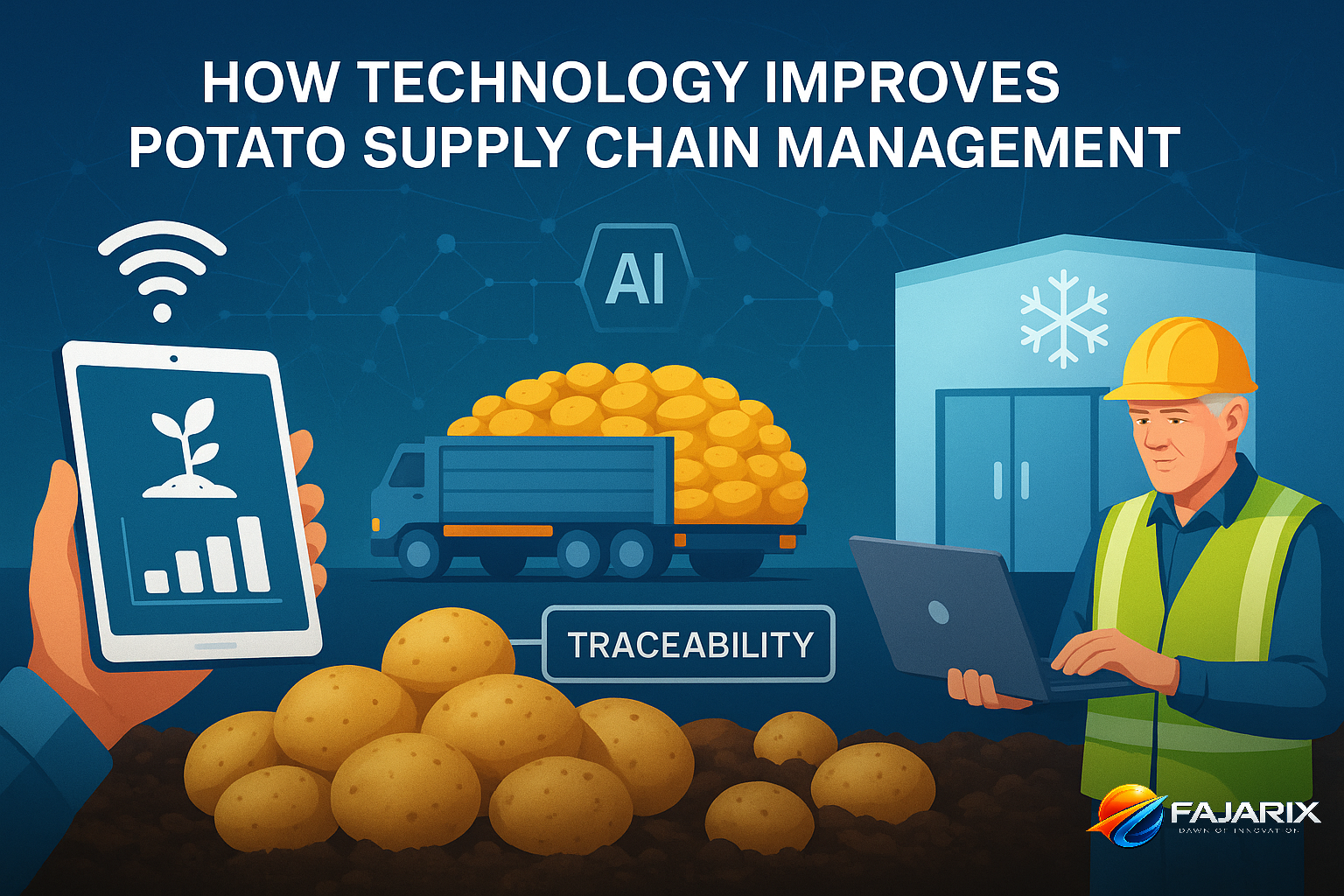
How technology improves potato supply chain management is the use of software, sensors, connectivity, and AI to track potatoes from farm to retailer, predict demand, optimize storage and transport, and reduce shrinkage. For CTOs and operators, it turns a low-margin, high-volume commodity into a measurable system with better yield visibility, lower waste, and faster decisions.
The potato is a useful case study because it looks simple and is operationally brutal. It is perishable, bulky, seasonal, price-sensitive, and sold through fragmented networks of growers, aggregators, cold stores, processors, distributors, and retailers. If your stack can handle potatoes well, it can usually handle onions, citrus, dairy, frozen foods, and a good portion of broader food logistics.
That is why how technology improves potato supply chain management matters beyond agriculture. It is really a lesson in inventory truth, traceability, demand forecasting, and operational control under uncertainty.
Why Potatoes Expose Supply Chain Weaknesses So Clearly
Potatoes move through a chain where small mistakes compound. A one-degree storage drift, a delayed truck, poor grading data, or a retailer promotion that was not shared upstream can erase margin quickly. Unlike high-margin packaged goods, there is not much room to hide bad decisions.
In practice, the common failure points are predictable: inconsistent lot tracking, spreadsheet-based procurement, no live visibility into cold-room conditions, weak demand signals from retail, and manual reconciliation between warehouse, transport, and finance systems. The result is overstock, spoilage, stockouts, and pricing decisions made too late.
For a CTO, the lesson is straightforward: do not start with “AI for agriculture.” Start with data capture, event integrity, and operational workflows. AI only works after the basics are reliable.
How Technology Improves Potato Supply Chain Management in Practice
How technology improves potato supply chain management in practice is not one platform. It is a stack of systems that create visibility at each handoff: farm intake, grading, storage, transport, processing, wholesale, and retail replenishment.
The Core Technology Layers
- Traceability systems: lot IDs, barcodes, QR codes, and batch records tied to origin, grade, treatment, and movement history.
- IoT monitoring: temperature, humidity, CO2, airflow, door-open events, and power status in cold storage and trucks.
- Demand forecasting: ML models that combine seasonality, promotions, weather, geography, and historical sell-through.
- Warehouse and transport software: WMS, TMS, route planning, dock scheduling, and proof of delivery.
- Decision automation: alerts, reorder recommendations, storage setpoint optimization, and exception workflows.
Named tools vary by stack and market. We commonly see combinations such as SAP, Microsoft Dynamics 365, Oracle NetSuite for ERP; Blue Yonder or o9 for planning; Samsara, Monnit, or PTC ThingWorx for IoT telemetry; and custom apps built around AWS IoT Core, Azure IoT Hub, or GCP pipelines.
The strategic point is that how technology improves potato supply chain management depends less on buying a giant suite and more on integrating a few high-trust data flows well.
How Does Traceability Work for Potatoes?
At a minimum, traceability works by assigning each potato lot a digital identity at intake, then preserving that identity through grading, storage, shipment, processing, and retail delivery. The system must record transformations, not just locations, because lots are often split, merged, washed, packed, or reclassified.
What Good Traceability Actually Captures
- Grower, field, harvest date, and variety
- Grade, size profile, defects, and moisture readings
- Storage room assignment and environmental history
- Transfers between facilities and transport events
- Processing or packing actions that create new child lots
- Retail or distributor destination and sell-by windows
This is where many implementations fail. Teams track “inventory” but not lineage. When quality issues appear, they can see where stock is, but not which upstream conditions caused the issue. That is operationally weaker than most leaders realize.
If you cannot answer “which lots were exposed to suboptimal storage conditions for more than six hours” in under five minutes, you do not have traceability. You have warehouse bookkeeping.
For many operators, a pragmatic architecture is a central event model exposed through APIs, with scanning apps for intake and dispatch, plus sensor streams attached to storage rooms and reefer vehicles. This is often a better investment than blockchain-heavy designs that add complexity before data discipline exists.
How Technology Improves Potato Supply Chain Management Through Cold-Storage Optimization
How technology improves potato supply chain management most visibly is in cold storage, where margin is won or lost. Potatoes are highly sensitive to temperature, humidity, airflow, and storage duration. The wrong conditions can increase shrinkage, sprouting, sugar buildup, or texture problems that make product unsuitable for fresh retail or processing.
What to Optimize in Cold Storage
- Environmental stability: maintain target temperature and humidity ranges by variety and end use.
- Energy efficiency: reduce compressor runtime and peak load without compromising quality.
- Lot rotation: issue inventory based on age, condition, customer requirement, and route economics.
- Exception response: alert fast on power loss, door breaches, sensor drift, or hot zones.
In real deployments, even basic telemetry can reduce spoilage by meaningful percentages because operators stop discovering problems during manual inspections. A cold room that drifts overnight is no longer a next-morning surprise; it becomes a live incident with an escalation path.
For CTOs, the implementation detail that matters is sampling, not just sensing. A sensor every room is not enough if airflow patterns create microclimates. You need placement strategy, calibration routines, and alert thresholds tied to business impact, not generic engineering defaults.
A Practical KPI Set
| KPI | Why It Matters | Typical Decision Trigger |
|---|---|---|
| Storage shrink % | Direct margin leakage | Investigate room, supplier, or handling process |
| Out-of-spec hours | Quality risk accumulation | Escalate maintenance or reclassify lot |
| Energy per ton stored | Operating efficiency | Adjust setpoints or equipment scheduling |
| Lot age by destination | Freshness and service level | Reallocate to nearer or lower-spec channel |
| Sensor uptime and drift | Data trust | Recalibrate or replace devices |
How Does AI Demand Forecasting Help Potato Retail and Processing?
AI demand forecasting helps by predicting how much potato inventory each channel will need, when, and in what form factor. Good models reduce overbuying, emergency replenishment, and markdowns while improving fill rate for retailers and processors.
Potato demand is not one curve. Fresh table potatoes, fries, chips, seed stock, and foodservice packs behave differently. Promotions, weather, holidays, Ramadan in some markets, school schedules, and regional eating habits all matter. A useful model must forecast at the right grain: SKU, store cluster, or customer segment.
Inputs That Usually Matter More Than Teams Expect
- Promotion calendars and discount depth
- Local weather, especially temperature swings and rainfall
- Regional holidays and pay-cycle effects
- Store-level stockouts, which distort historical sales
- Quality grade availability from upstream supply
- Lead time variability between cold store and retail DC
Technically, this is a good use case for gradient boosting or time-series ensembles before reaching for complex deep learning. In many food chains, the bigger gain comes from correcting dirty sales history and stockout bias than from using a fancier model.
This is another place where how technology improves potato supply chain management is often misunderstood. The value is not “better dashboards.” The value is changing purchasing, replenishment, and storage decisions early enough to matter.
Is IoT Worth It for Potato Warehouses and Transport Fleets?
Yes, if you connect IoT to decisions. Sensors alone are not worth much. The ROI comes when temperature breaches trigger dispatch changes, maintenance tickets, claims workflows, or inventory reallocation before product quality degrades.
Where IoT Usually Pays Back Fastest
- Cold rooms: continuous monitoring replaces manual checks and catches drift early.
- Reefer trucks: in-transit visibility reduces disputes and protects high-risk loads.
- Loading bays: door-open and dwell-time data expose process bottlenecks.
- Power systems: outage alerts protect inventory during grid instability.
In Pakistan and many emerging markets, power quality and connectivity are practical constraints, not edge cases. That changes architecture. You need offline buffering, battery-backed gateways, and operational tolerance for delayed sync. This is one of those details that looks minor in a slide deck and becomes decisive in production.
Fajarix Perspective: Build the Workflow Before the Model
One pattern we see repeatedly at Fajarix is leadership teams asking for forecasting or computer vision before they have stable intake workflows. A grader enters quality notes in one format, warehouse staff use another, and finance reconciles a third. No model can rescue that.
Our bias is to start with a narrow operational loop: intake, lot creation, storage assignment, dispatch, and exception handling. Once those events are structured and timestamped, forecasting and optimization become far cheaper and more reliable. This is the same discipline we apply in product engineering and logistics software: make the system observable before making it intelligent.
A typical first release does not need to be large. It often includes a supervisor dashboard, a mobile scanning app, sensor ingestion, and a rules engine for alerts. That is enough to create measurable wins in 8-12 weeks if the client already has clear operational ownership.
Fajarix Perspective: The Real Architecture Decision Is Buy, Build, or Hybrid
Founders often frame this as ERP versus startup software. The better framing is system of record versus system of action. Your ERP may remain the record for inventory valuation and finance, while custom software handles lot events, mobile workflows, and optimization logic.
For potato operations, a hybrid approach is usually strongest:
- Keep ERP for finance, procurement, and master data.
- Use IoT platforms for device management and telemetry.
- Build custom operational apps where process detail is your competitive edge.
- Expose everything through APIs so retailer, distributor, and processor integrations stay manageable.
This is where teams waste money if they are not careful. We have seen companies spend six figures extending an ERP UI for warehouse operators when a focused mobile workflow would have delivered better adoption in a fraction of the time. If your workers are on loading docks or in cold rooms, the UX constraint is physical, not just digital. Good UI/UX design matters more than executives expect.
What Mistakes Do Companies Make When Digitizing Food Supply Chains?
The biggest mistake is treating digitization as reporting instead of control. If the data arrives after the operational decision, the project may look modern but does not improve economics.
Common Mistakes
- Over-scoping version one: trying to digitize every supplier, warehouse, and retailer at once.
- Ignoring master data: inconsistent SKU, lot, location, and unit definitions break analytics.
- Buying AI before instrumentation: no trustworthy event stream means no trustworthy model.
- Weak exception design: alerts fire, but nobody owns the response workflow.
- No offline mode: field and warehouse environments often have unreliable connectivity.
- Forgetting change management: supervisors and operators need incentives, training, and simple interfaces.
A contrarian point: not every traceability problem needs blockchain. In most potato chains, the hard part is not proving cryptographic immutability. It is getting accurate lot creation, transfer, and transformation data from busy humans in messy environments. Solve that first.
A Practical Roadmap for CTOs Evaluating This Space
If you are evaluating how technology improves potato supply chain management, use a staged plan tied to measurable outcomes rather than a broad transformation program.
- Map the chain: identify every handoff from harvest to retail and note where data is lost.
- Choose one margin leak: spoilage, stockouts, claims, or poor forecast accuracy.
- Instrument the process: scanners, lot IDs, sensor coverage, and operator workflows.
- Create an event layer: centralize lot, location, and condition events through APIs.
- Add decision rules: alerts, reallocation logic, FEFO rotation, and exception ownership.
- Layer forecasting and optimization: once event quality is stable, add ML where it changes decisions.
- Measure ROI monthly: shrinkage, service level, labor time, energy, and claims reduction.
For startups entering agri-retail or food logistics, this roadmap is often enough for an MVP. You do not need a giant platform to prove value. You need one painful workflow solved end to end, then expand. That is the same logic behind startup MVP development and targeted AI automation engagements.
By the time you finish that first loop, you will understand how technology improves potato supply chain management in a way that is actionable, not theoretical: better lot visibility, fewer quality surprises, tighter replenishment, and more disciplined margins.
Ready to put these insights into practice? The team at Fajarix builds exactly these solutions. Book a free consultation to discuss your project.
Ready to build something like this?
Talk to Fajarix →